

🧭 The Freelancer’s Edge
🏷️ Positioning & Offers
I’ve been thinking about how hard it is to narrow your positioning when you’re not entirely sure where your next enquiry will come from.
It’s easy to talk about attracting better-fit clients. It’s quite another thing to change what your website says when part of you is worried about turning away the few opportunities that might arrive.
I’ve been working through this tension myself.
At Zero Point Development, I’ve gradually shifted how I describe the work I want to do and the organisations I want to work with.
But there’s a difference between knowing where you want your business to go and feeling comfortable making that direction visible.
After all, I’ve spent years building WordPress websites, solving technical problems and helping clients with whatever comes up. Those are useful skills, and I don’t suddenly stop having them because I’ve decided to focus on a particular type of client.
So how much do I narrow the message without making perfectly good opportunities feel unwelcome?
It’s an interesting question when you’ve spent much of your freelance career being the person who can probably sort things out.
The Common Freelancer Challenge
One tension that kept coming up in my Uncomfortable Questions for WordPress Freelancers series was specialisation, replaceability, and being seen as just another available option.
For experienced freelancers, this isn’t necessarily about not knowing what they’re good at.
Often, they’re good at many things.
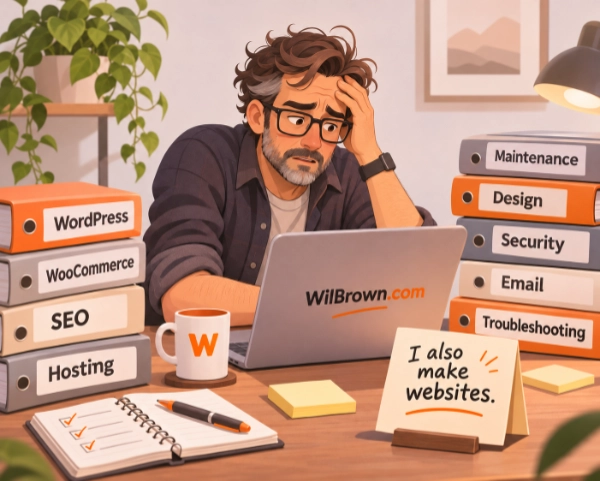
Over the years, we’ve accumulated a useful collection of skills. WordPress development, design, hosting, troubleshooting, WooCommerce, performance, SEO and the occasional mysterious plugin conflict that nobody else wants to investigate.
Naturally, we want potential clients to know we can help with all of those things.
And when enquiries slow down, it’s easy to make that list even longer.
We don’t want to give someone a reason to move on to the next freelancer.
The problem is that a long list of capabilities doesn’t necessarily give someone a reason to remember us, either.
Imagine someone in your network is talking with a business owner who needs help with a troublesome WooCommerce store.
They know three WordPress freelancers.
One does websites, SEO, hosting, maintenance, design and development.
Another is known for helping established online stores sort out unreliable checkout processes and technical problems.
Which one is easier to bring into the conversation?
That doesn’t mean the specialist is technically better. Or that the generalist couldn’t do an excellent job.
It means one of them has given the person making the referral a clearer reason to think of them.
A Better Way to Frame It
I’ve started thinking of positioning less as a statement of everything I’m willing to do and more as a way to help someone recognise when I’m particularly relevant.
That’s an important distinction.
Availability is not the same as relevance.
Being available for almost any WordPress project might feel commercially sensible, particularly when work is scarce.
But being relevant to a recognisable problem makes it easier for someone to remember you when that problem appears.
And I don’t think that means we all need to become ultra-specialists.
You can still accept work outside your preferred area. You can still help existing clients with all the miscellaneous WordPress problems you’ve always handled.
Your positioning doesn’t have to become a list of things you refuse to do.
It can simply give people a clearer starting point for understanding why they should contact you.
There’s also a practical reality worth acknowledging.
Changing your website’s messaging won’t magically create demand. If your referral network has gone quiet, you may need to investigate other problems. See my previous email newsletter, “The work was good. So why did the referrals stop?“
But when someone does hear about you, a clear message gives that opportunity a better chance of turning into a relevant conversation.
One Sentence Worth Revisiting
Here’s something small you can try without rebuilding your website or deciding on a permanent niche.
Find the sentence on your homepage that describes what you do.
Perhaps it says something like:
“I provide WordPress design, development, maintenance and SEO services for businesses of all sizes.”
There’s nothing technically wrong with that. It describes your capabilities.
But could you rewrite it to describe a problem you help solve?
For example:
“I help established WooCommerce businesses fix frustrating technical problems that interrupt sales.”
The second sentence doesn’t describe everything you can do.
It describes a situation in which someone might need you.
You don’t even have to publish your revised sentence straight away.
Write it down, read it aloud and ask whether someone in your network would find it easier to recognise an opportunity to refer you.
That’s the experiment.
Not choosing a niche for life. Just making one part of your value easier to explain.
A Quick Reflection
If someone who knows you professionally was asked, “What sort of WordPress work should I send their way?”, what do you think they’d say?
Would they describe a particular problem you’re good at solving?
Or would they say, “They do WordPress websites”?
Neither answer tells the whole story of your business.
But one might tell you something about how memorable your positioning has become.
Your Thoughts
I’d be interested to see how you’re currently describing your freelance business.
Hit reply and send me the one sentence you use to explain what you do.
It doesn’t need to be polished, and you certainly don’t need to rewrite your entire website first.
I’m interested in how experienced freelancers balance keeping opportunities open with becoming known for something specific.
Until next time,
Wil.